

Ptilonorhynchidae – Bowerbirds & Catbirds
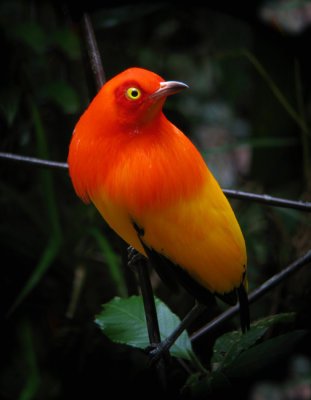
Ptilonorhynchida (Bowerbirds & Catbirds) constitute a small passerine family found only in Australia & New Guinea. They are renowned for their unique courtship behaviour, whereby males build a structure and decorate it with sticks and brightly coloured objects in an attempt to attract a mate. While the females are unequivocally drab, in some species the males have bright golden-yellow and sometimes black markings. The catbirds are much less conspicuous with green predominating.
They are medium to large-sized passerines, ranging from the Golden Bowerbird at 22 centimetres and 70 grams to the Great Bowerbird at 40 centimetres and 230 grams. Their diet consists mainly of fruit, but may also include insects (especially for nestlings), flowers, nectar and leaves in some species. (the Satin and Spotted Bowerbirds are sometimes considered agricultural pests due to their habit of feeding on introduce fruit and vegetable crops and they have occasionally been killed by orchardists.)
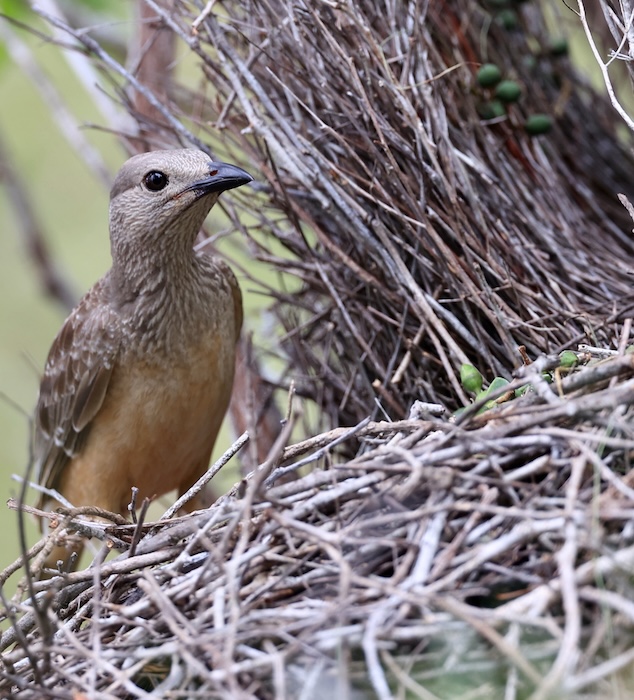
Fawn-breasted Bowerbird Chlamydera cerviniventris – ©Nick Ludovic Green Bird-Photo-Tours ASIA
The bowerbirds have an Austro-Papuan distribution, with ten species endemic to New Guinea, eight endemic to Australia. Although their distribution is centred on the tropical regions of New Guinea and northern Australia, some species extend into central, western, and southeastern Australia. They occupy a range of different habitats, including rainforest, eucalyptus and acacia forest, and shrublands.
Bowerbirds as a group have the longest life expectancy of any passerine family with significant banding studies. The two most studied species, the Green Catbird and Satin Bowerbird, have life expectancies of around eight to ten years and one Satin Bowerbird has been known to live for twenty-six years. For comparison, the Common Raven, the heaviest passerine species with significant banding records, has not been known to live longer than twenty-one years.
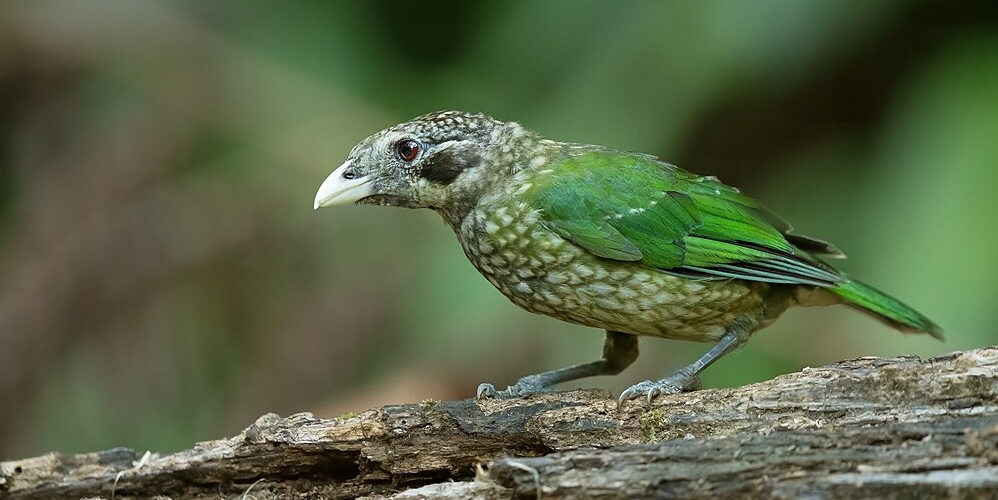
Spotted Catbird Ailuroedus maculosus – ©JJ Harrison CC BY-SA 4.0 via Wikimedia Commons
The most notable characteristic of bowerbirds is their extraordinarily complex courtship and mating behaviour, where males build a bower to attract mates. There are two main types of bowers. One clade builds so-called maypole bowers, which are constructed by placing sticks around a sapling; in some species, these bowers have a hut-like roof. The other major bower-building clade builds an avenue type-bower made of two walls of vertically placed sticks. In and around the bower, the male places a variety of brightly coloured objects he has collected. These objects, usually different among each species, may include hundreds of shells, leaves, flowers, feathers, stones, berries, and even discarded plastic items, coins, nails, rifle shells, or pieces of glass. The males spend hours arranging this collection.
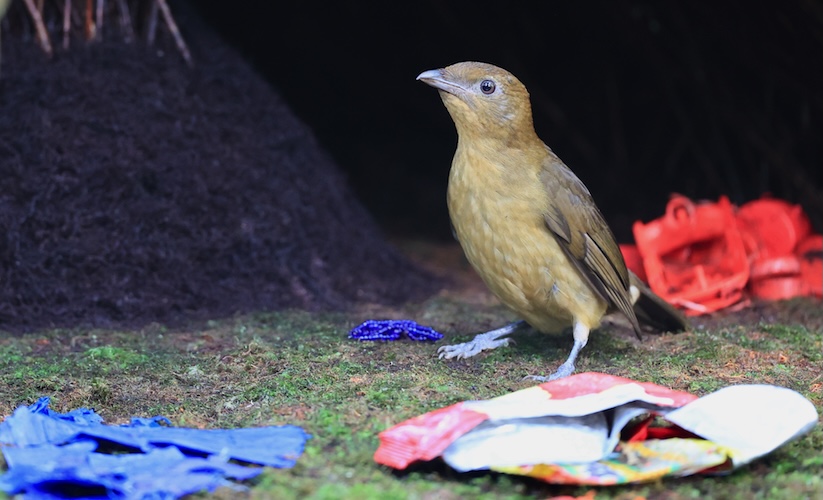
Vogelkop Bowerbird Amblyornis inornata – ©Nick Ludovic Green Bird-Photo-Tours ASIA
Bowers within a species share a general form, but do show significant variation, and the collection of objects reflects the biases of males of each species and its ability to procure items from the habitat, often stealing them from neighbouring bowers. Several studies of different species have shown that colours of decorations males use on their bowers match the preferences of females.
The Ailuroedus catbirds, which do not build bowers, are monogamous, with males raising chicks with their partners, but all other bowerbirds are polygynous, with the female building the nest and raising the young alone. These latter species are commonly dimorphic, with the female being drabber in colour. Female bowerbirds build a nest by laying soft materials, such as leaves, ferns, and vine tendrils, on top of a loose foundation of sticks.
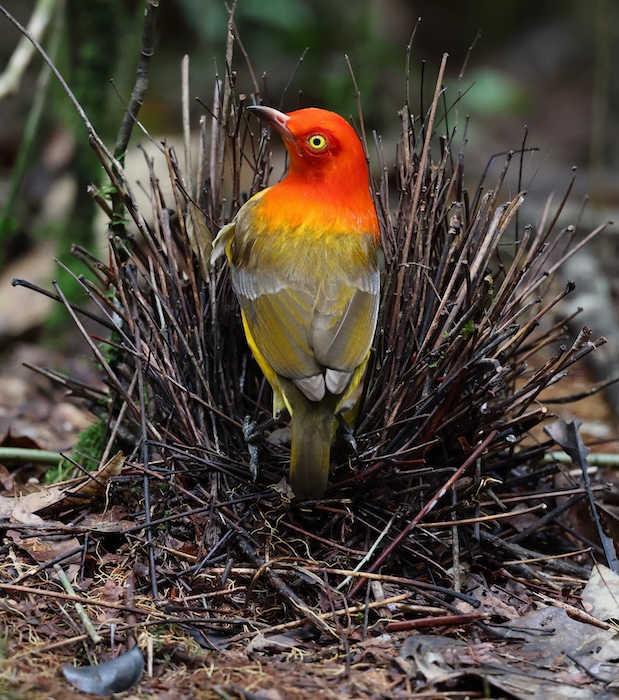
Flame Bowerbird Sericulus ardens – ©Nick Ludovic Green Bird-Photo-Tours ASIA
All Papuan bowerbirds lay one egg, while Australian species lay one to three with laying intervals of two days. Bowerbird eggs are around twice the weight of those of most passerines of similar size – for instance eggs of the Satin Bowerbird weigh around 19 g, as against a calculated 10 g for a passerine weighing 150 g. Eggs hatch after 19 to 24 days, depending on the species and are a plain cream colour for catbirds and the tooth-billed bowerbird, but in other species possess brownish wavy lines similar to eggs of Australo-Papuan babblers. In accordance with their lengthy incubation periods, bowerbirds that lay more than one egg have asynchronous hatching, but siblicide has never been observed.
-
Number of bird species: 23
(As at January 2026)
According to the recently (2025) amalgamated AviList, there are twenty-three species, in eight genera in the Ptilonorhynchidae family. They are:
Masked Bowerbird Sericulus aureus
Flame Bowerbird Sericulus ardens
Fire-maned Bowerbird Sericulus bakeri
Regent Bowerbird Sericulus chrysocephalus
Satin Bowerbird Ptilonorhynchus violaceus
Western Bowerbird Chlamydera guttata
Spotted Bowerbird Chlamydera maculata
Great Bowerbird Chlamydera nuchalis
Yellow-breasted Bowerbird Chlamydera lauterbachi
Fawn-breasted Bowerbird Chlamydera cerviniventris
White-eared Catbird Ailuroedus buccoides
Ochre-breasted Catbird Ailuroedus stonii
Tan-capped Catbird Ailuroedus geislerorum
Spotted Catbird Ailuroedus maculosus
Black-eared Catbird Ailuroedus melanotis
Green Catbird Ailuroedus crassirostris
Tooth-billed Bowerbird Scenopoeetes dentirostris
Golden Bowerbird Prionodura newtoniana
Vogelkop Bowerbird Amblyornis inornata
MacGregor’s Bowerbird Amblyornis macgregoriae
Streaked Bowerbird Amblyornis subalaris
Golden-fronted Bowerbird Amblyornis flavifrons
Archbold’s Bowerbird Archboldia papuensis
-
Birds of Paradise and Bowerbirds
| By Phil Gregory & Richard Allen | Helm | 2020 | Hardback | 416 pages, 41 plates with colour illustrations; colour photos, colour distribution maps | ISBN: 9780713660272 Buy this book from NHBS.com -
Bowerbirds Nature, Art & History
| By CB & D W Frith | 304 pages, colour & b/w photos, illustrations, maps |(Privately [published) | 2007 | Hardback | ISBN: 9781876473631 Buy this book from NHBS.com -
The Bowerbirds
| Edited by Clifford Frith | OUP | 2004 | Hardback | 416 pages, 16 col plates, 77 b/w illus, 26 maps | ISBN: 9780198548447 Buy this book from NHBS.com
-
Ptilonorhynchidae
Family AccountMost ptilonorhynchids live in tropical rainforests of New Guinea and Australia. Some of the Australian bowerbirds occupy edge habitat near rainforests. -
Ptilonorhynchidae
Family AccountBowerbirds make up the bird family Ptilonorhynchidae. They are renowned for their unique courtship behaviour, where males build a structure and decorate it...
Given the number of species in this family, Fatbirder does not provide quick links to all of them. However, the entries below do include links to representatives of every genera, all those illustrated and some of the most often encountered, iconic or sought-after species.
-
Archbold's Bowerbird Archboldia papuensis
Species AccountSound archive and distribution map. -
Archbold's Bowerbird Archboldia papuensis
Species AccountArchbold's bowerbird (Archboldia papuensis) is a passerine bird in the bowerbird family Ptilonorhynchidae that is endemic to highland forests of New Guinea. -
Fawn-breasted Bowerbird Chlamydera cerviniventris
Species AccountThe fawn-breasted bowerbird (Chlamydera cerviniventris) is a medium-sized, up to 32 cm (13 in) long, bowerbird with a greyish... -
Fawn-breasted Bowerbird Chlamydera cerviniventris
Species AccountSound archive and distribution map. -
Flame Bowerbird Sericulus ardens
Species AccountThe flame bowerbird (Sericulus ardens) is one of the most brilliantly coloured bowerbirds. The male is a medium-sized bird, up to 25 cm long. -
Flame Bowerbird Sericulus ardens
Species AccountSound archive and distribution map. -
Golden Bowerbird Prionodura newtoniana
Species AccountThe golden bowerbird (Prionodura newtoniana) is a species of passerine bird in the bowerbird family Ptilonorhynchidae. It is endemic to Queensland in Australia. -
Golden Bowerbird Prionodura newtoniana
Species AccountSound archive and distribution map. -
Green Catbird Ailuroedus crassirostris
Species AccountThe green catbird (Ailuroedus crassirostris) is a species of bowerbird found in subtropical forests along the east coast of... -
Green Catbird Ailuroedus crassirostris
Species AccountSound archive and distribution map. -
Regent Bowerbird Sericulus chrysocephalus
Species AccountSound archive and distribution map. -
Regent Bowerbird Sericulus chrysocephalus
Species AccountThe regent bowerbird (Sericulus chrysocephalus) is a medium-sized, up to 25 cm long, sexually dimorphic bowerbird. The male bird is black with a golden... -
Regent Bowerbird Sericulus chrysocephalus
Species AccountThe Regent Bowerbird is a small, slim bowerbird with a long, straight slender bill… -
Satin Bowerbird Ptilonorhynchus violaceus
Species AccountThe satin bowerbird (Ptilonorhynchus violaceus) is a species of passerine bird in the bowerbird family Ptilonorhynchidae that is endemic to eastern Australia. -
Satin Bowerbird Ptilonorhynchus violaceus
Species AccountSound archive and distribution map. -
Spotted Catbird Ailuroedus maculosus
Species AccountThe spotted catbird (Ailuroedus maculosus) is a species of bowerbird (Ptilonorhynchidae) which can be found in north Queensland, the eastern Moluccas and... -
Spotted Catbird Ailuroedus maculosus
Species AccountSound archive and distribution map. -
Tooth-billed Bowerbird Scenopoeetes dentirostris
Species AccountThe tooth-billed bowerbird (Scenopoeetes dentirostris), also known as the stagemaker bowerbird or tooth-billed catbird... -
Tooth-billed Bowerbird Scenopoeetes dentirostris
Species AccountSound archive and distribution map. -
Vogelkop Bowerbird Amblyornis inornata
Species AccountThe Vogelkop bowerbird (Amblyornis inornata), also known as the Vogelkop gardener bowerbird, is a medium-sized bowerbird of the mountains of West Papua. -
Vogelkop Bowerbird Amblyornis inornata
Species AccountSound archive and distribution map.